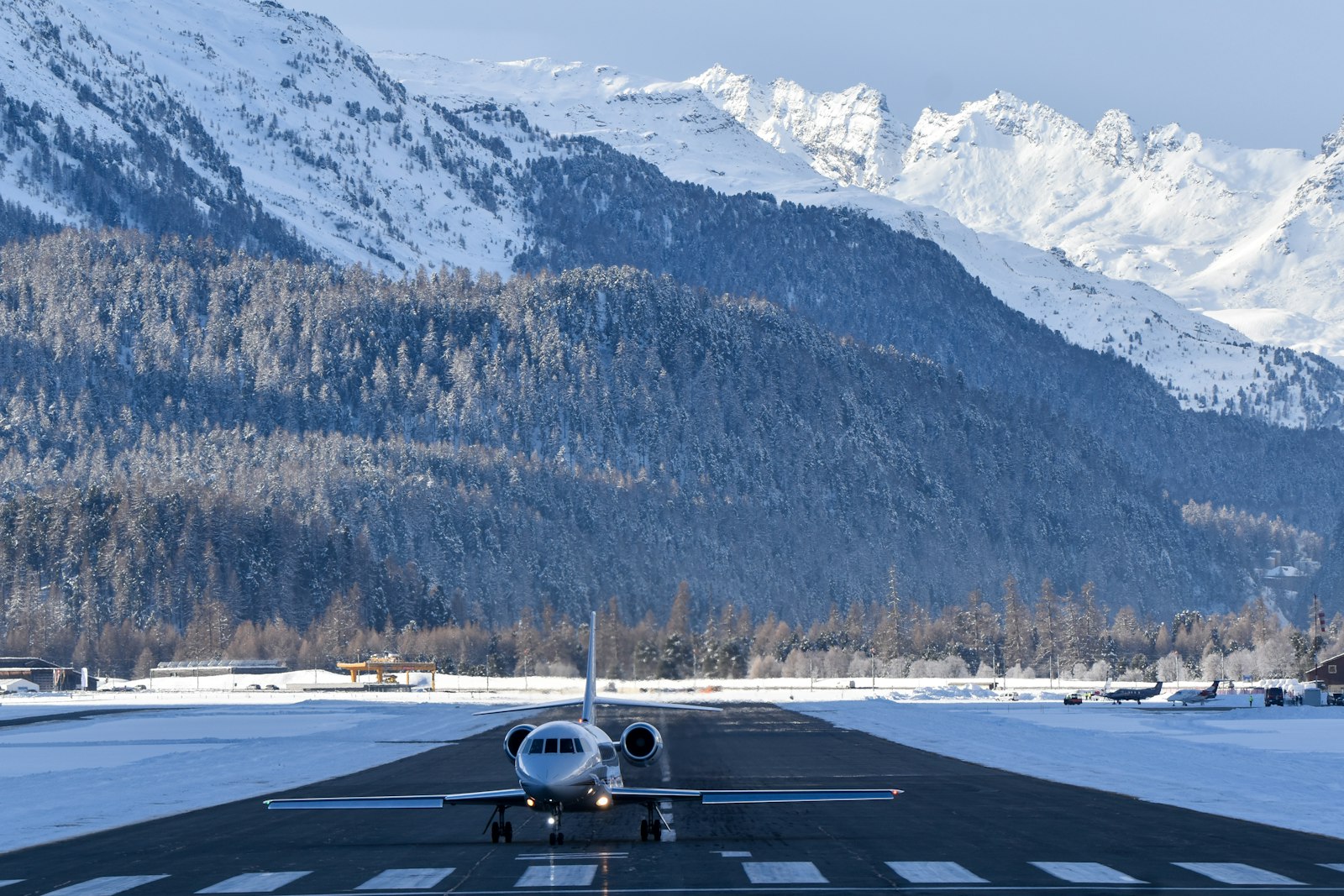
When you charter a private jet, you pay for the aircraft and its crew for the whole trip: the hours flown on the type you choose, any empty legs it flies to reach you or get home, airport and handling fees, crew costs, and taxes charged per passenger. That is why two quotes for one route can differ widely.
Choosing the aircraft is the easy decision. What protects you is duller work, such as confirming who actually operates the flight and knowing how your airport treats private traffic in the week you travel.
Picking the aircraft
Start from the longest leg and the luggage, then take the smallest aircraft that handles both without strain. The manufacturers' own figures give a fair idea of each class. The destination can also rule a class out: Aspen's runway takes wingspans of up to 95 feet, which keeps the largest long-range jets away, as our Aspen concierge page explains.
- Turboprops such as the Pilatus PC-12, with a maximum range of 1,765 nautical miles according to Pilatus, can use short and even unpaved runways that most jets cannot, which opens up small islands and mountain airfields.
- Light jets such as the Pilatus PC-24, rated at up to 2,000 nautical miles, or Cessna's Citation CJ4, carry a few passengers on hops like Paris to Nice or London to Geneva.
- Midsize and super-midsize jets add space to move around and cross Europe in one go. Cessna gives the Citation Latitude 2,700 nautical miles, and Bombardier quotes up to 3,400 for the Challenger 3500, with seats for up to ten.
- Long-range jets fly between continents without a stop. Dassault's Falcon 6X is rated at 5,500 nautical miles with a cabin 1.98 metres high, while the Gulfstream G700 and the Bombardier Global 8000 claim 7,750 and 8,000.
Treat brochure range as a best case. Gulfstream works out the G700's figure with eight passengers and four crew on board, and Bombardier quotes the Global 8000 with the same load. A full cabin, a winter headwind on a westbound crossing or a hot afternoon on a short runway all eat into it. That is why an operator may suggest a fuel stop or a bigger aircraft for a route that looks easy on paper.
What the price is made of
Operators price each aircraft type by the flight hour, and that hourly rate is the figure people compare. It rarely explains the gap between two offers. The quote is built on top of it, and these are the lines that move.
Positioning and waiting
A one-way trip usually pays for the empty flight back to base, unless the operator has another client for it. If you return within a few days, ask for the trip priced two ways: with the aircraft and crew waiting for you, which adds crew hotels and parking, and with the aircraft flying home and coming back. Which is cheaper depends on how far away it is based, so the aircraft closest to your departure airport often wins on price even with a higher hourly rate.
Taxes charged per passenger
France's solidarity levy on air travel has its own scale for business aircraft, and charter flights pay it. Since 1 March 2025, the ministry's published rates for a jet have been €420 per passenger for a destination in France, the EU or the EEA, or within 1,000 km. Intermediate distances pay €1,015 and long haul €2,100. A business turboprop pays €210 per passenger on that short-haul band. Six friends flying from Paris to Mykonos by jet therefore pay €2,520 in this levy alone.
The UK applies a higher rate of Air Passenger Duty to aircraft of 20 tonnes or more with fewer than 19 seats, which catches the large-cabin jets. From 1 April 2026 it is £142 per passenger to the EU and other nearby destinations and £1,097 or more for long haul, rising to £146.63 on the shorter routes from April 2027. Smaller jets are not caught by the higher rate.
Airports, crews and peak weeks
Landing and handling fees are billed airport by airport, and crew duty limits can turn a long day out and back into an overnight stop. In the busiest weeks the nearest free aircraft may be far away, and you pay for its journey to you. The common mistake is to book on the lowest hourly rate and only notice these lines afterwards.
Empty legs, used well
An empty leg is cheap because another client has already paid for the aircraft to make that flight. You inherit their timetable, so it suits a flexible one-way trip with light bags and nothing fixed at the other end.
Before you build a weekend around one, price an ordinary one-way on an aircraft already based at your departure airport. With no positioning to pay for, it can cost less than people expect, and it does not depend on a stranger's plans.
Four airports and how they work
Paris-Le Bourget
Le Bourget, about 11 kilometres north-north-east of Paris, lost its last airline traffic in 1980 and now serves private and business aviation. In 2027 the Paris Air Show takes over the site from 14 to 20 June, the same week as VivaTech, so anyone flying privately into Paris that week should settle the aircraft and the hotel early.
Nice, Cannes-Mandelieu and Saint-Tropez
Nice has a business aviation terminal with its own customs post, opened in 2010, and parking for around 120 business aircraft depending on their size. Like Cannes-Mandelieu, it is a fully slot-coordinated airport, so every movement needs an allocated time. For the Monaco Grand Prix or the Film Festival, ask where the aircraft will wait: if it cannot stay at Nice, it drops you and repositions, and the extra legs appear on the bill. Monaco is then seven minutes away by helicopter from Nice airport.
Cannes-Mandelieu, by its own account France's number two for business aviation, is closer to the Croisette and suits lighter jets, while the largest aircraft use Nice. Its control tower opens at 8am and closes at 8pm in winter, at 10pm from 4 May to 23 August and at 9pm in between.
La Môle, the airfield for Saint-Tropez, has a runway of 1,071 metres. Jet crews need a specific qualification, which includes a check flight alongside an instructor from the aviation authority, before they can use it. The airfield also asks for 24 hours' notice and accepts flights from outside the Schengen area only from 1 July to 15 October. Many private flights land at Nice instead, with a helicopter or a car for the last stretch.
Farnborough
Farnborough, in Hampshire, presents itself as the largest business aviation airport in the UK. Border and security checks happen on site, cars can drive up to the aircraft, and the airport puts central London under an hour away by road or 12 minutes by helicopter. Visitors who need the UK's Electronic Travel Authorisation need it for a private flight too.
Geneva and the Alps
At Geneva, every business aviation movement needs prior permission, booked by the handling agent, and the airport's booking window opens only five days ahead. For ski weeks, when Saturdays bring the chalet changeovers, the request should go in the moment that window opens, and a winter departure can add de-icing to the bill.
For St. Moritz, Engadin Airport at Samedan takes private jets, but its winter day ends with evening civil twilight, which means planning every arrival for daylight. Our St. Moritz guide covers the transfer into town.
Checks before you pay
Within the EU, carrying passengers for payment is reserved for airlines holding an operating licence and an air operator certificate (AOC), as the French civil aviation authority, the DGAC, reminds travellers. Brokers are legal and often useful, but the contract should name the operator that holds the certificate. The DGAC publishes lists of French aeroplane and helicopter operators with a valid AOC, updated on 3 November 2026, so a name takes minutes to check.
The authority is blunt about the alternative. When a company or a lone pilot invoices a flight without those authorisations, the DGAC calls it illegal public transport. Safety is not guaranteed, the pilots may be less qualified and their working hours unregulated, and insurers can refuse to pay after an accident. The same page explains when a shared-ownership scheme crosses the line into selling flights.
- Ask for the insurance certificate. EU rules require passenger liability cover of at least 250,000 special drawing rights per passenger, and the document should name the operator and the aircraft.
- Read the cancellation terms as a calendar of dates and percentages, and get in writing what happens if the aircraft has a technical fault before departure.
- Check that the per-passenger taxes appear in the quote, since they are the easiest line to leave out of a headline price.
- Send passport details early, because the crew and the airports need them for flights crossing a border.
Frequently asked questions
How much does it cost to charter a private jet?
It depends on the aircraft's hourly rate, the empty positioning and the taxes, so we quote each trip in writing. Some costs are fixed by law: a jet leaving France for an EU destination pays €420 per passenger in French solidarity levy, and a large-cabin jet leaving the UK pays £142 per passenger in Air Passenger Duty to the EU.
What is the difference between a charter broker and an operator?
The operator holds the air operator certificate, employs the crew and flies the aircraft. A broker sources aircraft from operators on your behalf. Both are legitimate, and your contract should always name the operator.
How do I check that a charter flight is legal?
Ask for the operator's name and AOC number, then check them with the authority that issued the certificate. In France, the DGAC publishes the list of operators with a valid AOC. If nobody can name the certificate holder, do not fly.
How far in advance should I book a private jet?
For an ordinary European trip, a few days is often enough to find a suitable aircraft. For the Monaco Grand Prix, the Cannes Film Festival, Christmas and New Year, or February ski weekends, book as soon as your dates are fixed, because the aircraft and the airport slots go first.
Planning a private flight with TG Hospitality
Send us the route, the dates, the passengers and the bags, skis and golf clubs included. Through our private jet and helicopter service we come back with options from licensed operators, each naming the aircraft, the operator and the full price with positioning and taxes. We add the cars and, on the Riviera, the helicopter. If a scheduled fare suits the trip better, we say so, and our guide to business and first class fares explains how we get those below public prices on selected routes. The quickest way to start is WhatsApp (+33 6 35 38 69 09), or use our contact page.