For a first trip to China, we would choose Beijing, Xi'an and Shanghai, linked by high-speed train, over 10 to 12 days. On a second trip, or with two weeks, add Chengdu and Chongqing for food and pandas, Hangzhou and the Xiandu valley in Zhejiang, or the south: Guangzhou, Xiamen and the Li River.
For each place, we give what it is like, where we would stay, how many nights it needs and how it connects to the next. Entry rules, flights and payments are in our guide to why 2027 is the year to visit China.
Beijing and Xi'an
Beijing, three or four nights
Beijing is where imperial China is best preserved: the Forbidden City, the Temple of Heaven, the Summer Palace, and the Great Wall within a morning's drive. The Forbidden City sells tickets online only, released a week ahead, and your passport serves as the ticket at the gate. They go fast at weekends and in holiday weeks, so after the flights it is the first thing we book.
For the Wall, Mutianyu, in Huairou District, has enclosed cable cars and a slide back down, which children love. For a longer and quieter walk, we would go further out, to Jinshanling.
The PuXuan, on Wangfujing Street close to the Forbidden City, is a calm, pared-back hotel in the old centre. Rosewood Beijing, in Chaoyang, suits a longer stay, and its 830-square-metre indoor pool earns its keep in winter.
Xi'an, two nights
Xi'an's great sight lies outside the city. The Terracotta Army guards the tomb of China's first emperor at Lintong, about 35 km to the north-east, and we would go early with a private guide, ahead of the tour groups. Come back for a late-afternoon walk on the Ming city wall, which runs for about 14 km around the old centre, and dinner in the Muslim Quarter.
The Sofitel Legend People's Grand Hotel, a state guesthouse from 1953 with French, Russian and Art Deco touches, has 71 rooms and One MICHELIN Key. The fastest trains from Beijing take about four and a quarter hours, and Chengdu is three hours or so further on.
Shanghai and Zhejiang
Shanghai, three nights
Shanghai is the easiest city in China for a first visit. The Bund's old banks and hotels face the towers of Lujiazui across the Huangpu, and to the west the former French Concession keeps its plane trees, villas and small restaurants. Spend at least one evening on the Bund, when the far bank lights up. In 2027, the Chinese Grand Prix fills the city from 16 to 18 April.
The Peninsula sits on the Bund itself, with Art Deco-inspired interiors and the river in front. Upper House Shanghai, formerly The Middle House, is a quieter design hotel in Dazhongli, in Jing'an. For a slower stay, Amanyangyun lies just outside the city, its antique stone villas spread across 140 hectares of relocated camphor forest.
Hangzhou, two nights
Hangzhou is an hour or so from Shanghai by train and far greener. Most visitors circle West Lake; we prefer the lake at dawn, then the tea villages in the hills behind it. Amanfayun is in one of those valleys, six kilometres from the lake, with 46 village dwellings, some more than a century old, among tea fields and seven ancient Buddhist temples.
Xiandu, one night
Xiandu is the name on this list that few travellers know. It is a national 5A scenic area in Jinyun County, in the hills of southern Zhejiang, where the Lianxi River winds through farmland below 160 peaks. Its name means "capital of immortals", and tradition credits it to the Tang emperor Xuanzong.
The landmark is Dinghu Peak, a single column of rock almost 171 metres tall, shaped like a giant bamboo shoot, which rises straight out of the valley floor. Go at first light, when mist lies on the river and the paths are empty, then visit the Taoist temple and the cliffs of Mini Red Cliff.
Jinyun West station, on the Jinhua to Wenzhou high-speed line, is about two hours from Hangzhou, and a driver can meet you there. Places to stay near the scenic area are guesthouses and small design hotels, so we either book the best of them for one night or make Xiandu a long day out from Hangzhou.
Sichuan and Chongqing
Chengdu, two or three nights
Chengdu is where we send people who travel to eat. Sichuan cooking is the draw, from hotpot to dan dan noodles, along with the teahouses in the parks and the pandas at the Chengdu Panda Base, the city's breeding and research centre. Go at opening time, ahead of the crowds.
Upper House Chengdu, until recently The Temple House, is built around a restored heritage courtyard in Taikoo Li, in the middle of the city. Outside town, at the foot of Mount Qingcheng, Six Senses Qing Cheng Mountain has courtyard villas, some with their own pools, and a spa that draws on Taoist healing.
Chongqing, two nights
Chongqing, an hour from Chengdu by fast train, is the most dramatic city in China, stacked on steep hills where the Jialing River meets the Yangtze. After dark, the stilted buildings of Hongyadong light up along the Jialing, and by day you can ride the Line 2 monorail through Liziba station, which sits inside a 19-storey block of flats. Eat hotpot at least once, and avoid July and August, when the heat is punishing.
Niccolo Chongqing is a sky hotel in Tower 1 of Chongqing IFS, with a pool, spa and gym high above the meeting of the two rivers.
Southern China, from Guangzhou to Guilin
Guangzhou, two nights
Guangzhou is the home of Cantonese cooking, and dim sum in the morning with a long Cantonese dinner at night is reason enough to stop. It is also the easiest way into the mainland from Hong Kong, since trains from West Kowloon reach Guangzhou South in as little as 47 minutes. If you start there, our Hong Kong guide covers the city and the train.
Rosewood Guangzhou fills the top floors of one of the city's tallest towers, in Tianhe, and some rooms look straight at the Canton Tower. Mandarin Oriental, on Tianhe Road nearby, is the other hotel we would consider.
Xiamen, two nights
Xiamen is the gentlest stop on the list, a seaside city with good seafood and an easy pace. Its draw is Gulangyu, the small island opposite, listed by UNESCO as Kulangsu, a Historic International Settlement, for the mix of Chinese and Western buildings put up after it became an international settlement in 1903. It has never had a bridge, so you cross by ferry and explore on foot.
A long day inland reaches the Fujian tulou, the great earthen communal houses of the province's south-west, 46 of which are on UNESCO's list. In town, Conrad Xiamen occupies the 37th to 54th floors of one of the Shimao Strait twin towers, looking out to sea and across to Gulangyu. From Guangzhou, the fastest trains take under three hours; from Shanghai or Beijing, we would fly.
Guilin and Yangshuo, two or three nights
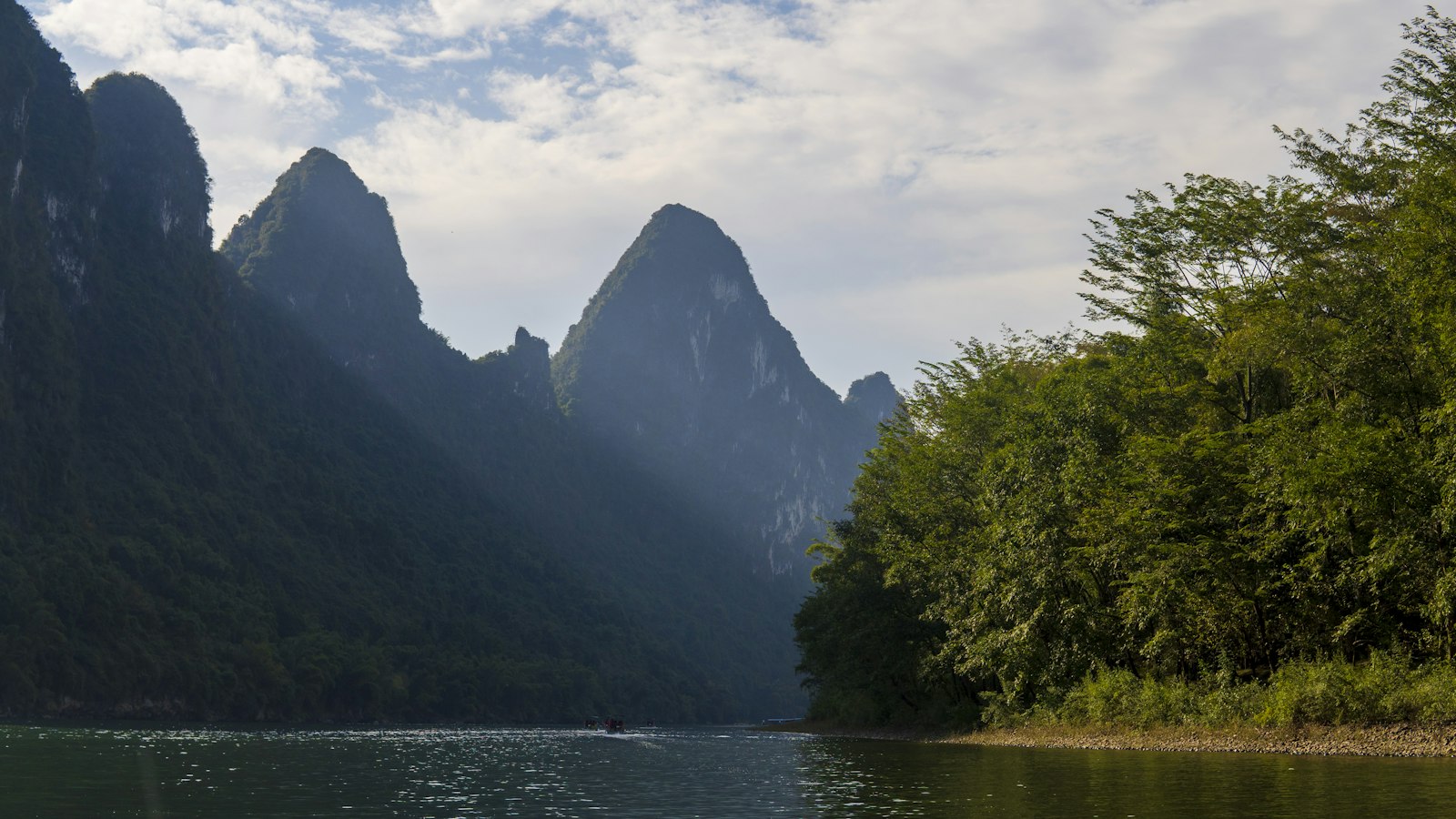
The karst peaks along the Li River are the China of scroll paintings, and the stretch between Guilin and Yangshuo is the classic one. We would stay in Yangshuo, take a bamboo raft on the quieter Yulong River and give an afternoon to Xingping, an old town on the east bank of the Li. Banyan Tree Yangshuo has villas looking over the river and the peaks, about 35 minutes by car from Yangshuo station, and Guilin is about two hours from Guangzhou by fast train.
How we would link them
Take the train for anything up to about five hours and fly beyond that. On the fastest trains we book business class, whose seats recline flat, and because tickets are tied to your passport, the names on the booking must match it exactly.
- A first trip of 9 to 11 nights: Beijing for four, Xi'an for two and Shanghai for three, with Hangzhou for two if you have them. Fly into Beijing and home from Shanghai.
- Food and landscapes in 11 nights: Shanghai for three, Hangzhou for two and Xiandu for one, then a flight to Chengdu for three and the train to Chongqing for two, flying home from there or via Hong Kong.
- The south in seven nights, starting in Hong Kong: the train to Guangzhou for two, Guilin and Yangshuo for three, then on to Xiamen for two before heading home.
For Americans on the 240-hour transit, every place in this guide lies inside the areas open to transit visitors, Guilin, Chengdu and Xiandu included. The whole stay must still fit within 10 days and end with a departure to a third country or region.
Frequently asked questions
Where should I go in China for the first time?
Beijing, Xi'an and Shanghai, in either direction, over 10 to 12 days with fast trains in between. Together they give you imperial Beijing, the Terracotta Army and modern Shanghai, and every journey between them can be done by train.
How many days do you need in Beijing and Shanghai?
Three or four nights in Beijing and three in Shanghai. Beijing has more to see, and the Great Wall takes most of a day. Shanghai is at its best in the evenings and needs less sightseeing time.
Is it better to take the train or fly between Chinese cities?
Take the train for journeys of up to about five hours, since the stations are usually closer to town than the airports and the fastest service from Beijing to Shanghai takes about four hours 20 minutes. Fly for longer legs, such as Shanghai to Chengdu or Beijing to Guilin.
Can you combine Hong Kong and mainland China in one trip?
Yes. Fast trains from West Kowloon reach Guangzhou in under an hour and run on to Shanghai and Beijing, with the mainland border checks done in the station before departure. Under the rules in force until 31 December 2026, most European, British, Canadian and Australian passports need no visa for mainland stays of up to 30 days.
Planning your China route with TG Hospitality
Tell us how many nights you have and what you most want to see, and we will draw the route. Then we book the flights, the hotels at preferential rates, the train seats, the Forbidden City and panda base tickets, and a driver and guide in each city, Xiandu included. Our team works in five languages, Chinese among them, and Shanghai and Hong Kong are on our locations page. Write to us on WhatsApp or through our contact page with your dates.